



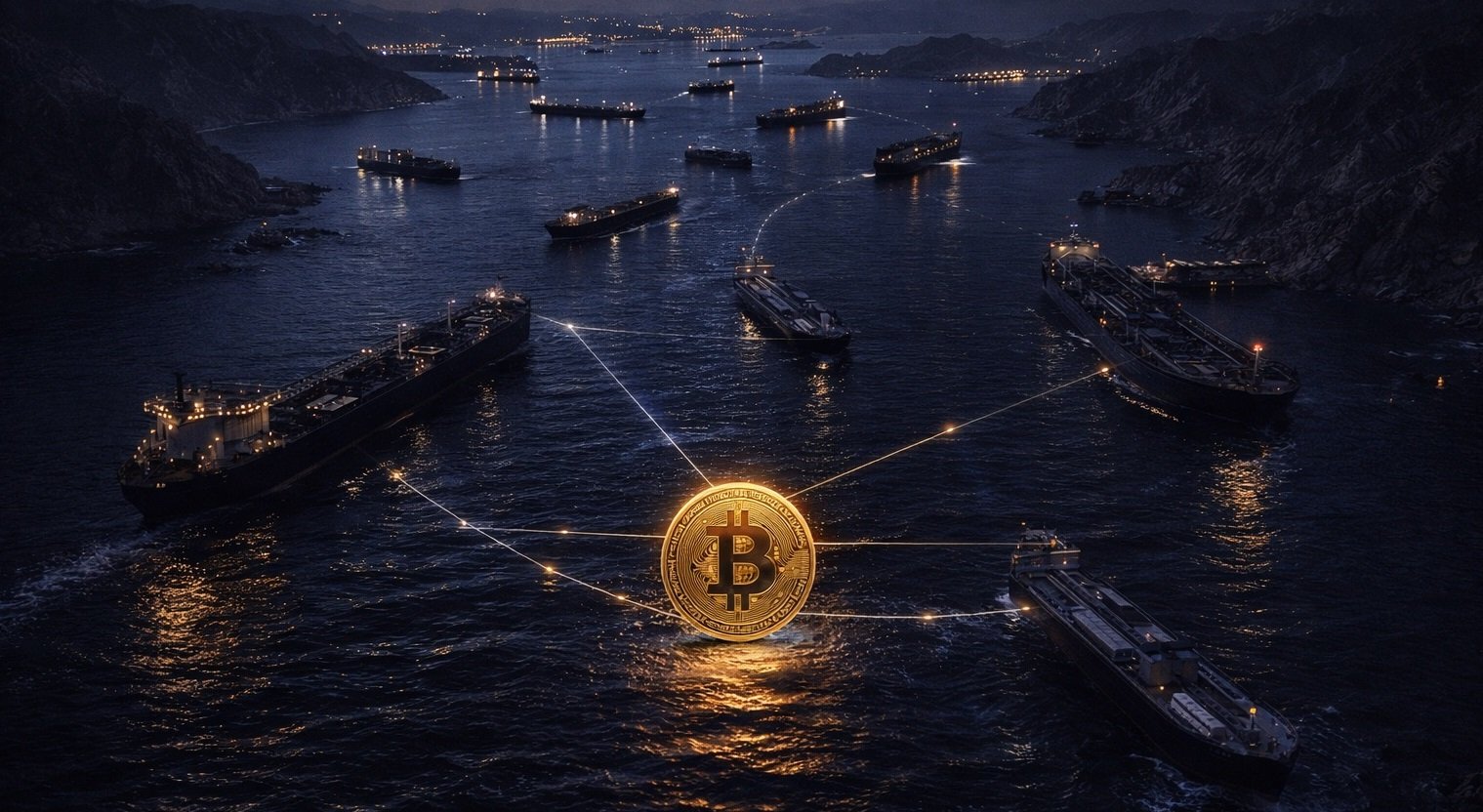
The Strait of Hormuz has long been recognized as the single most strategically important waterway in the global energy system. Connecting the Persian Gulf to the Gulf of Oman, it serves as the primary export corridor for crude oil produced across the Middle East. But in an extraordinary development that merges modern cryptocurrency finance with centuries-old geopolitical leverage, Iran has announced plans to impose a $1-per-barrel Bitcoin toll on every oil tanker seeking to transit the strait, at least during the fragile two-week ceasefire negotiated with the United States.
This decision transforms what has historically been a contested but commercially open waterway into something entirely new: a crypto-gated chokepoint where digital payments are the price of passage.
Why It Matters So Much to Global Energy Markets
Before diving into the mechanics of Iran’s toll system, it is essential to understand why the Strait of Hormuz oil transit route commands such enormous global attention. At its narrowest point, the strait measures roughly 21 miles wide, with navigable shipping lanes occupying only a small portion of that distance. Yet through this relatively modest corridor flows approximately one-fifth of the world’s seaborne oil supply. This volume encompasses crude exports from Saudi Arabia, the United Arab Emirates, Kuwait, Iraq, and Iran itself, as well as significant quantities of liquefied natural gas (LNG).
Any disruption to shipping through the Strait of Hormuz sends shockwaves through energy markets worldwide. Refineries in Asia, Europe, and the United States that depend on Middle Eastern crude cannot easily switch suppliers on short notice. Spot prices respond almost immediately to any credible threat to the strait’s navigability, and insurance underwriters raise war-risk premiums for vessels operating in the region within hours of political escalation. This is why analysts have described the strait as the “jugular vein” of the global oil supply, a chokepoint so critical that even a partial closure would cause serious economic disruption across multiple continents.
Iran has long understood this leverage. For decades, Iranian officials have periodically threatened to close the strait during periods of confrontation with the United States or Western powers, particularly when sanctions have tightened around Tehran’s oil exports.
Those threats have historically been treated as strategic signaling rather than genuine operational plans. What makes the current situation categorically different is that Iran is not merely threatening to disrupt transit; it is seeking to monetize it, using decentralized digital currency to collect revenues specifically designed to evade the sanctions architecture that Western governments have spent years constructing.
Iran’s Bitcoin Toll Scheme: How the System Is Designed to Work
According to the Financial Times, the toll system requires shipping companies to begin the process before their vessels even enter the strait. Tanker operators must first email a detailed cargo manifest to Iranian authorities, including the nature, origin, and destination of the cargo on board. This pre-notification requirement gives Tehran the ability to assess each shipment before granting or withholding permission to proceed, a form of prior restraint over commercial shipping that has no precedent in peacetime maritime law.
Once Iranian authorities have reviewed the manifest, they open a very narrow payment window. According to Hamid Hosseini, spokesperson for Iran’s Oil, Gas and Petrochemical Products Exporters’ Union, vessels are given only a brief period described as “a few seconds” to complete payment in Bitcoin. The extremely compressed payment window appears deliberately designed to make the transactions difficult to document and challenge through conventional financial compliance frameworks. Because Bitcoin transactions, once broadcast to the blockchain, are effectively irrev
ersible and pseudonymous with respect to the receiving wallet’s real-world identity, this approach provides Iran with a mechanism for receiving funds that is far harder for international sanctions authorities to intercept or freeze than wire transfers through the conventional banking system.
The financial scale of these Bitcoin payments for Strait of Hormuz transit is substantial. Modern crude oil tankers typically carry cargoes ranging from 500,000 barrels for smaller Aframax-class vessels up to 2 million barrels or more for Very Large Crude Carriers (VLCCs). At a rate of $1 per barrel, a single VLCC transit could generate a Bitcoin payment of up to $2 million. Multiply this across the dozens of tankers that would normally pass through the strait each day, and the aggregate revenue potential for Tehran becomes very significant, potentially hundreds of millions of dollars over the two-week ceasefire period alone, if traffic approaches pre-conflict levels.
Hosseini was candid about the dual purpose of the system, stating that while everything is technically permitted to pass through, “the procedure will take time for each vessel, and Iran is not in a rush.” This openly acknowledged deliberate slowing of traffic serves the stated aim of preventing weapons shipments from reaching hostile parties during the ceasefire, while simultaneously generating cryptocurrency revenue that sanctions cannot easily reach. It also gives Iranian authorities granular, real-time control over who passes through a waterway that international maritime law has traditionally treated as a route for innocent passage.
Cryptocurrency as a Sanctions Evasion Tool: The Broader Context
Iran’s decision to denominate the Strait of Hormuz oil tanker toll in Bitcoin rather than any conventional currency is not accidental. It reflects a broader strategic calculation that has been developing within Iran’s economic planning circles for several years. As US sanctions have progressively cut Iran off from the SWIFT international payments network and made dollar-denominated transactions effectively impossible for most Iranian entities, Tehran has increasingly explored cryptocurrency as an alternative financial channel.
Iran began officially authorizing the use of cryptocurrency for import payments in 2019, recognizing that digital assets could provide a workaround for sanctions-related banking restrictions. The country also operates significant Bitcoin mining capacity, taking advantage of subsidized domestic energy prices to generate cryptocurrency for international transactions. By requiring toll payments in Bitcoin for Strait of Hormuz shipping fees, Iran is effectively institutionalizing sanctions evasion at the chokepoint, turning the world’s most critical oil transit corridor into a live demonstration of how crypto assets can be weaponized in geopolitical conflict.
This approach creates significant compliance headaches for Western shipping companies and their regulators. A tanker operator based in Greece, Japan, or South Korea faces an uncomfortable choice: pay the Bitcoin toll and risk secondary sanctions violations under US law, or refuse to pay and lose access to one of the most important trade routes in the world. Legal and compliance teams at major shipping firms are almost certainly scrambling to determine whether participation in the toll system constitutes a sanctionable transaction under the Office of Foreign Assets Control (OFAC) regulations, and whether the ceasefire arrangement provides any temporary legal cover.
For cryptocurrency markets themselves, the establishment of a mandatory Bitcoin oil transit fee by a major oil-producing state represents a novel and significant use case. Bitcoin advocates have long argued that the asset’s censorship-resistant properties make it valuable in precisely these kinds of scenarios, where conventional payment rails are unavailable or politically compromised. The Iran toll scheme provides a real-world test of that thesis at a geopolitical scale that no previous cryptocurrency application has approached.
The Ceasefire Framework: What Led to This Moment
The toll scheme is inseparable from the broader diplomatic context in which it has emerged. A fragile ceasefire between the United States and Iran followed weeks of military confrontation that had effectively closed the Strait of Hormuz to oil tankers, sending energy prices sharply higher and threatening to trigger a severe supply shock in crude markets. The two-week truce was structured around a conditional reopening of the strait, with Iran agreeing to permit transit under its own terms. At the same time, diplomatic talks proceed, reportedly including a planned meeting between US and Iranian officials in Pakistan.
A senior Iranian official told Reuters that a limited, Iran-controlled reopening of the strait could happen as soon as Thursday or Friday following the ceasefire announcement, a timeline that suggested Tehran was prepared to move quickly to establish its tollbooth regime once the truce was formalized. The “limited, under Iran’s control” framing is significant: it signals that Iran does not view the ceasefire as a restoration of the pre-conflict status quo, but rather as an opportunity to establish a new normal in which Iranian authority over the strait is formally acknowledged through the payment mechanism itself.
Oil markets responded dramatically to the news of the ceasefire. Brent crude futures, the international benchmark, fell approximately 13% to around $94.76 per barrel after President Trump confirmed the two-week truce. US benchmark West Texas Intermediate (WTI) dropped even more sharply, declining more than 15% to around $95.79. These moves reflected the market’s relief that the worst-case scenario, a prolonged closure of the Strait of Hormuz affecting global oil supply, had been at least temporarily averted.
However, the persistence of prices in the mid-$90s range, well above pre-conflict levels, indicates that traders continue to price in meaningful uncertainty about whether the corridor will remain open and on what terms.
Trump’s “Joint Venture” Proposal: American Tolling Ambitions
One of the most striking dimensions of the emerging situation is that the United States government, rather than categorically rejecting the concept of strait tolls, appears to have been actively contemplating its own version of the same idea. President Donald Trump, speaking to ABC News journalist Jonathan Karl, floated the notion of transforming the tolling arrangement into a joint business venture between the US and Iran. “We’re thinking of doing it as a joint venture,” Trump stated, describing it as “a way of securing it, also securing it from lots of other people. It’s a beautiful thing.”
This framing is remarkable on several levels. It suggests that Trump is approaching the Strait of Hormuz geopolitical situation less through the lens of international maritime law, which generally guarantees innocent passage through international straits, and more through the transactional lens of commercial deal-making. The idea that the world’s most critical oil chokepoint could be restructured as a revenue-generating joint venture between two countries that have been adversaries for more than four decades represents a radical departure from established US foreign policy doctrine.
It also raises profound questions about precedent. If the United States were to participate in or endorse a tolling regime on the Strait of Hormuz, it would implicitly validate the principle that coastal states can impose fees on transiting vessels, a principle that, if extended to other strategic waterways globally, could have far-reaching implications for international trade and freedom of navigation. Other states controlling important chokepoints may argue that they are entitled to similar arrangements. The commercial logic that Trump finds appealing in the Strait of Hormuz could be used to justify restrictions on transit that the United States has historically opposed.
What a $1-Per-Barrel Surcharge Really Means for Global Oil Trade
At first glance, $1 per barrel is a modest imposition when crude oil is trading in the mid-$90s. But this framing misses the structural significance of what Iran is establishing. The toll is not simply a cost of doing business; it is a geopolitical tax that formalizes Iranian sovereignty over a route that international law treats as a global commons. Accepting the toll, even at a low per-barrel rate, represents an implicit acknowledgment that Iran has the right to set the terms of transit.
Moreover, the $1-per-barrel figure is the announced rate for the current ceasefire period. Nothing is preventing Iran from raising the toll in subsequent negotiations, or from applying differential rates to shipments from countries it views as hostile. A tiered system in which allies pay less and adversaries pay more would give Tehran an enormously powerful instrument of economic coercion without ever firing a shot. The Strait of Hormuz Bitcoin toll system could evolve from a temporary crisis measure into a permanent feature of the global energy landscape if the international community acquiesces during the current ceasefire window.
For shipping companies calculating the economics of Strait of Hormuz transit costs, the arithmetic is sobering even at current rates. A VLCC carrying 2 million barrels faces a $2 million toll per transit, a cost that will ultimately be passed through to refiners, then to consumers in the form of higher fuel prices. Asian importers, who are by far the largest customers for Persian Gulf crude, would bear the greatest share of this burden. Japanese, South Korean, Chinese, and Indian refiners collectively account for a dominant share of the tanker traffic subject to the toll, and their governments are watching the situation with understandable alarm.
Legal and Maritime Law Implications
The imposition of a mandatory toll on commercial vessels transiting the Strait of Hormuz sits in deeply contested legal territory. Under the United Nations Convention on the Law of the Sea (UNCLOS), international straits used for international navigation are subject to a right of transit passage, a right that is more expansive than the “innocent passage” standard applicable to territorial seas, and that cannot be suspended or subjected to fees by the coastal state. Iran, notably, is not a party to UNCLOS, but the transit passage regime is widely considered to reflect customary international law binding on all states.
Shipping industry lawyers and maritime law scholars are likely to challenge the legal basis for Iran’s toll on these grounds. However, in a conflict or post-conflict environment where Iran controls the physical access to the strait with naval forces, legal arguments offer limited protection to tanker crews and cargo owners. The choice between paying the toll and losing access to the corridor is ultimately a commercial and political calculation, not a purely legal one.
The requirement for cargo manifests to be submitted to Iranian authorities before transit also raises significant concerns about intelligence gathering and cargo interception. By requiring advance notification of all shipments, Iran gains visibility into the flow of goods through the strait, which could be used for purposes well beyond toll collection, including identifying shipments of military or dual-use goods, mapping the commercial relationships of adversary states, and identifying vessels that could be targeted if hostilities resume.
The Strait of Hormuz in a Crypto-Enabled Geopolitical World
The convergence of cryptocurrency technology with one of the world’s most consequential geopolitical flashpoints marks a genuinely new chapter in the history of the Strait of Hormuz and digital assets. For years, cryptocurrency advocates argued that blockchain-based assets would eventually play important roles in international trade and finance, roles that would go beyond speculative investment to encompass real transactional utility in challenging environments. The Iran toll scheme is a crude but operationally real example of that thesis being tested at scale.
For policymakers, energy traders, shipping executives, and geopolitical analysts, the coming weeks will be closely watched. Whether the ceasefire holds, whether the toll system becomes institutionalized, whether the US pursues Trump’s joint venture concept, and whether Western governments attempt to sanction participation in the Bitcoin payment scheme, all of these questions will shape how the Strait of Hormuz oil shipping route functions in the months and years ahead.
What seems clear is that the chokepoint has entered a new phase in its history, one in which digital finance, energy geopolitics, and the fragile architecture of international law are more deeply intertwined than ever before.
The Strait of Hormuz, which for decades represented the ultimate test of whether conventional military deterrence could keep global energy supplies flowing, has now become a test of something more complex: whether the world’s most critical maritime corridor can be governed in an era of cryptocurrency, sanctions evasion, and transactional diplomacy. The answer will matter enormously not just for oil markets, but also for the broader question of how international order functions when the tools of finance and those of geopolitics become indistinguishable from one another.