


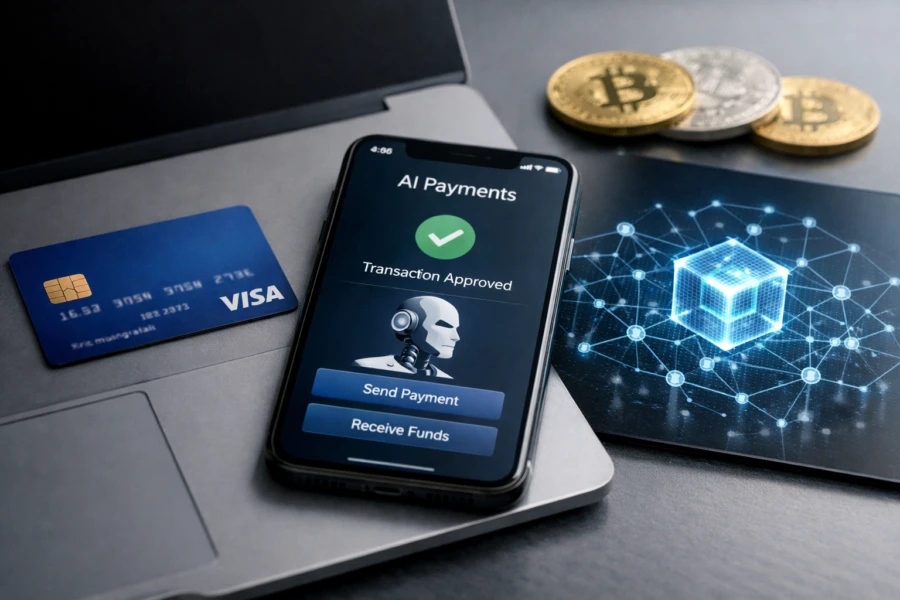
The traditional payments ecosystem has long relied on a straightforward model: a human decides to make a purchase, and a bank or card network processes the transaction. However, this model is evolving rapidly with the emergence of the Visa Payment System for AI, a groundbreaking approach that introduces artificial intelligence as an active participant in financial transactions.
As AI technologies continue to advance, payment networks are being redesigned to accommodate a new type of “user” intelligent software agents capable of making purchasing decisions on behalf of individuals and businesses.
Visa Payment System for AI
The Visa Payment System for AI is currently being explored through Visa’s innovative “Agentic Ready” program in Europe. This initiative focuses on testing how financial systems can support AI-initiated payments while maintaining security, compliance, and trust.
In collaboration with major banking institutions such as Commerzbank and DZ Bank, Visa is working to ensure that existing payment infrastructure can seamlessly adapt to this transformative shift. The goal is to allow AI agents to search for products, evaluate options, and complete purchases autonomously based on predefined user instructions.
At the core of the Visa Payment System for AI is the concept of machine-driven transaction initiation. Unlike traditional payments, which require explicit human confirmation, AI agents operate according to rules, goals, and data inputs defined by users. For example, an AI-powered system could monitor inventory levels, compare supplier prices, and automatically place orders when stock runs low or when favorable pricing conditions are met. This level of automation has the potential to significantly streamline purchasing processes, especially for repetitive or routine transactions.
One of the most critical challenges the Visa Payment System for AI addresses is redefining how transactions begin. Existing payment systems are built around verifying human identity and intent, typically through authentication methods like PINs, passwords, or biometrics. As AI agents initiate transactions, financial institutions must develop new mechanisms to verify that these agents are acting legitimately on behalf of users. This involves creating secure digital identities for AI systems and establishing clear frameworks for authorization and accountability.
Security and compliance remain central to the development of the Visa Payment System for AI. Banks participating in early trials are rigorously testing how AI agents can operate within strict regulatory environments without increasing risks. Fraud prevention, audit trails, and customer consent are key considerations, as any failure in these areas could lead to significant financial losses. Industry reports have already highlighted that AI-related incidents can result in costly consequences, underscoring the importance of robust safeguards in this evolving ecosystem.
Another important aspect of the Visa Payment System for AI is its focus on infrastructure rather than consumer-facing applications. Visa is not simply building tools for end users; instead, it is redesigning the underlying payment network to function effectively when the “customer” is an AI system. This includes determining how transactions are authenticated, how approvals are managed, and how disputes are resolved if something goes wrong. These foundational changes are essential to ensure that AI-driven payments can scale safely and reliably.
In enterprise environments, the Visa Payment System for AI could revolutionize procurement processes. Large organizations often face complex approval workflows for purchasing, which can slow operations. AI agents can simplify these workflows by handling routine purchases within predefined limits, reducing manual intervention, and increasing efficiency. However, this also requires organizations to establish clear policies and boundaries to prevent errors, misuse, or unintended spending.
The growing adoption of AI across industries is further accelerating the relevance of the Visa Payment System for AI. Businesses are increasingly investing in AI to automate back-office operations, improve decision-making, and reduce operational costs. At the same time, regulators are paying closer attention to how AI is used in sensitive areas such as financial transactions, credit evaluation, and fraud detection. This dual focus on innovation and oversight will shape how AI-driven payment systems evolve in the coming years.
Ultimately, the Visa Payment System for AI represents a significant shift in how financial transactions are initiated and managed. While human oversight will remain essential, the day-to-day act of making payments may increasingly be handled by intelligent systems operating within defined parameters. As Visa continues to test and refine this technology, it is clear that the future of payments will involve a new kind of participant AI agents that do not carry cards but can still execute transactions with precision and efficiency.
As this technology matures, the Visa Payment System for AI could become a cornerstone of the next generation of digital commerce, enabling faster, smarter, and more autonomous financial interactions.