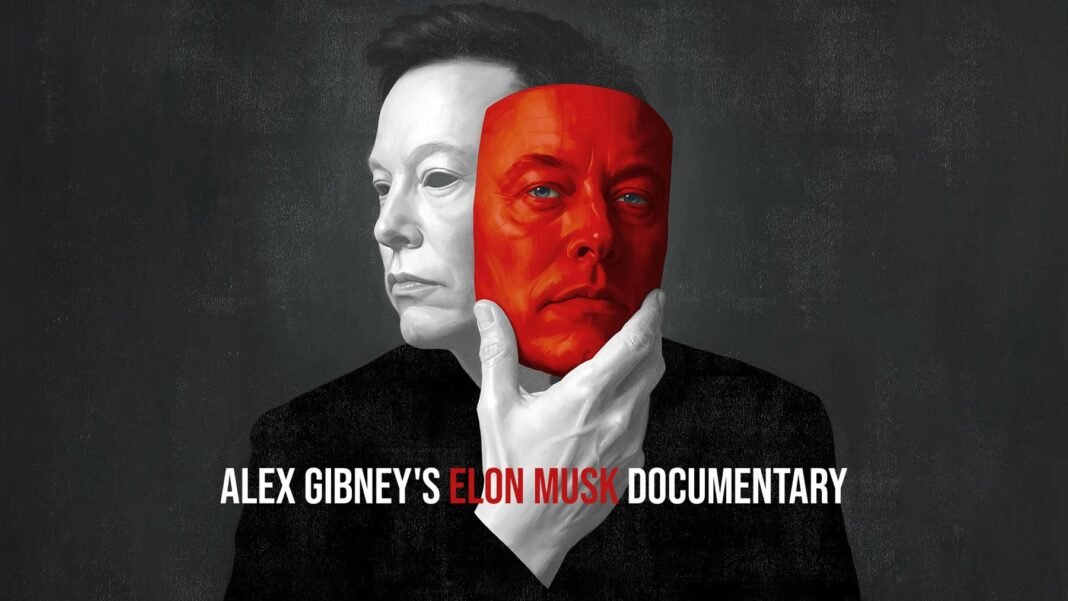

I have watched enough documentaries about powerful men to know when a filmmaker is padding a runtime and when he is building a case. Alex Gibney’s new Elon Musk documentary, simply titled “Musk,” runs close to four hours, and after digging into everything reported about it, I can tell you it earns almost every minute.
This is not a hagiography, and it is not a hit piece, despite what Musk himself has called it. It is closer to a prosecutor’s closing argument, built from court filings, whistleblower testimony, and years of tape that Musk never intended anyone to stitch together this way.
Gibney is not a newcomer to this kind of work. He is the Oscar-winning director behind “Enron: The Smartest Guys in the Room,” “Taxi to the Dark Side,” and “Going Clear,” his examination of Scientology. Each of those films shares a theme: an institution or a man convinces the public of something that turns out to be far more fragile and far more damaging than it appeared.
The new Elon Musk documentary applies that same lens to the world’s richest person, and the result is uncomfortable in ways I did not expect.
Why This Elon Musk Documentary Starts
Most profiles of Musk open with rockets or electric cars. This Elon Musk documentary opens somewhere colder: the Social Security Administration’s NUMIDENT database, the record that contains identification data for every American who has ever held a Social Security number, roughly 300 million people.
According to court filings and a whistleblower complaint from the SSA’s own Chief Data Officer, DOGE-affiliated staffers copied that database into an unsecured cloud testing environment, in some instances after a federal court had already ordered them to stop.
That is the spine of the film. Gibney is not arguing that Musk is merely eccentric or overexposed. He is arguing that Musk’s actual power comes from two sources most people underestimate: control of market narrative and control of data, not engineering brilliance. Calling Musk a “dangerous huckster” is Gibney’s own phrase, and it sets the tone for everything that follows in this Elon Musk documentary.
The Video Game Avatar, Explained
Because Musk declined to sit for an interview and publicly dismissed the project, Gibney’s team scraped years of archival audio and built a first-person shooter-style avatar of Musk, complete with health bars and respawns, to narrate portions of his own life. I understand why that choice sounds like a gimmick on paper. It is not.
Musk has spent years suggesting that reality itself might be a simulation. Gibney simply put him inside one. The audio is authentic, even if the visual wrapper is synthetic, and the effect lands as pointed commentary rather than cheap trickery.
The “Ten Thousand Lasers” Text and the Election
One of the more talked about scenes in this Elon Musk documentary involves Ashley St. Clair, one of the mothers of Musk’s children, describing text exchanges from before the 2024 election. She recalls Musk expressing unusual certainty about the outcome, referencing something he called an “anomaly in the matrix” and a reference to having lasers in space, which most read as a nod to his Starlink satellite network.
Gibney does not claim this proves election manipulation. He leaves the interpretation open, somewhere between a troll and a confession, and lets the ambiguity sit with the viewer rather than forcing a conclusion the evidence cannot support.
That restraint is actually one of the film’s strengths. This Elon Musk documentary is careful, at multiple points, to separate what is documented from what is merely suspicious. The SSA data movement is confirmed by court records. What Musk or DOGE actually did with access to hundreds of millions of Americans’ sensitive information is, in Gibney’s own words, not something anyone outside that circle currently knows.
DOGE, Super Admin Access, and Why That Matters
During Musk’s roughly four-month stint leading the Department of Government Efficiency, his young staffers reportedly obtained what one of Gibney’s sources, a former federal IT executive, described as super admin status across multiple government systems. That level of access, paired with the elimination of roughly 270,000 federal jobs and cuts to programs including USAID under Samantha Power, forms the backbone of the film’s second act.
The Elon Musk documentary does not claim this data was weaponized. It asks whether the infrastructure now exists for it to be and whether anyone would necessarily know if it happened.
Sam Harris, once a friend of Musk and now openly critical of him, appears near the end of the film making a version of the same point: one person’s instability now has consequences that ripple through politics, markets, and geopolitics simultaneously. That is the throughline of this Elon Musk documentary. It is less interested in Musk as a personality and more interested in what it means when that much unchecked power concentrates in a single, unelected individual.
Starlink, SpaceX, and the Quiet Consolidation of Infrastructure
Beyond the data story, this Elon Musk documentary spends real time on how thoroughly Musk’s companies have embedded themselves into public infrastructure.
Starlink now plays a documented role in the war in Ukraine and other conflict zones, effectively giving one private citizen leverage over military communications.
NASA’s dependence on SpaceX for crewed launches has deepened to the point where alternatives barely exist. Gibney frames these not as isolated business wins but as evidence of a slow transfer of public function into private, personally controlled hands.
Where the Film Stops Short
I want to be fair here, because plenty of coverage will flatten this into simple outrage. The Elon Musk documentary does not present technical proof that Musk personally accessed or misused the SSA data.
Gibney says so directly. What the film does establish, through court filings and named whistleblowers, is that improper access happened, that it violated a court order in at least some instances, and that the infrastructure for far larger misuse now exists.
The gap between “this happened” and “this was weaponized” is exactly where Gibney wants the audience sitting, uncomfortable and asking questions, rather than handed a tidy verdict.
When and Where to See It
“Musk” premieres at the Venice Film Festival in September before playing the Toronto International Film Festival, with a U.S. theatrical release from Bleecker Street set for October 16, ahead of an HBO Max streaming debut. At nearly four hours with an intermission, it is a genuine sit, closer to a limited series than a typical theatrical documentary. If you plan to watch only one Elon Musk documentary this year, and there will likely be competitors given how much attention Musk continues to attract, this is the one built on the most rigorous paper trail.
My Take
I have covered enough corporate and political power stories to be skeptical of documentaries that promise a smoking gun and deliver innuendo instead.
This Elon Musk documentary mostly avoids that trap by sourcing its biggest claims to court records and named whistleblowers rather than anonymous insinuation. Where it speculates, mainly around what DOGE did with the data it accessed, Gibney says so plainly instead of dressing up a guess as a revelation. That honesty is rare in this genre, and it is the reason this particular Elon Musk documentary is worth four hours of your time even if you think you already know everything about its subject.