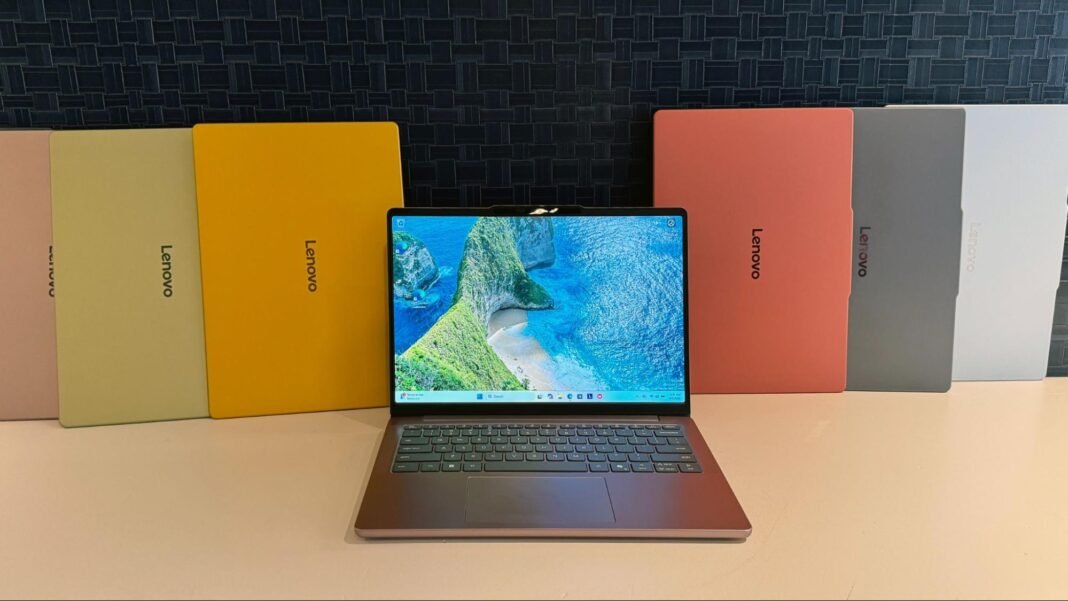

The affordable laptop market is getting much more interesting. Lenovo has introduced the new Lenovo IdeaPad Vibe, a laptop designed to compete directly with Apple’s MacBook Neo while giving buyers something the Neo does not offer in the same way: choice.
Starting at $699.99 in the US, the Lenovo IdeaPad Vibe combines multiple processor options, larger display choices, upgradeable hardware, and a surprisingly colorful design. Lenovo will offer the laptop in 14-inch and 15-inch versions, with AMD Ryzen AI 400 and Qualcomm Snapdragon X processors initially available. Intel models are also planned for a later date.
The result is a Lenovo IdeaPad that looks considerably more ambitious than the typical affordable Windows notebook.
Lenovo IdeaPad Vibe Takes Aim at Apple
Apple changed expectations for inexpensive premium laptops with the MacBook Neo. Lenovo appears to understand that buyers looking for a roughly $700 computer no longer want a machine that feels cheap simply because it costs less.
The Lenovo IdeaPad Vibe takes a different approach. Instead of offering one fixed configuration, Lenovo is giving customers several ways to configure the laptop. That includes processor choices, different display technologies, memory options, and storage configurations.
The starting price is particularly important because the Lenovo IdeaPad Vibe arrives at essentially the same $699 price point as the MacBook Neo.
That makes this less of a budget laptop launch and more of a direct challenge to Apple’s affordable MacBook strategy.
Seven Colors Make the Lenovo IdeaPad Vibe Different
Design is probably the first thing people will notice about the Lenovo IdeaPad Vibe. Lenovo is offering seven colors, including Dreamy Violet, Spicy Gold, Zen Green, Chill Blue, Radiant Coral, Moody Blue, and Lowkey Gray. The company is also introducing interchangeable keycaps, allowing users to customize the appearance of the keyboard.
This is a clever move because most laptops in this price range look remarkably similar. Silver, gray, and black dominate the category.
The Lenovo IdeaPad Vibe gives buyers a reason to consider the laptop based on personality as well as specifications. It is still a productivity machine, but Lenovo clearly wants it to feel less generic.
Two Display Sizes Give Lenovo an Advantage
Another major advantage of the Lenovo IdeaPad Vibe is its choice of screen sizes. Buyers can select between 14-inch and 15-inch models. Display options include IPS panels with refresh rates up to 120Hz, while selected configurations can be equipped with OLED displays. Touchscreen functionality is also available on certain models.
The MacBook Neo, by comparison, has a 13-inch display. For students, office workers, and people who regularly work with multiple windows, the larger Lenovo IdeaPad could be more practical. A 15-inch laptop is not necessarily the best choice for everyone, but having the option is valuable.
Hardware Is Where the Lenovo IdeaPad Gets Interesting
Lenovo is offering the Lenovo IdeaPad Vibe with AMD Ryzen AI 400 processors and Qualcomm Snapdragon X chips. Intel versions are expected later.
The AMD version is particularly interesting for buyers who care about upgradeability. Lenovo says AMD configurations can support up to 32GB of RAM, while Snapdragon models support up to 24GB. Storage can reach 1TB, and the AMD versions provide dual SSD slots.
That is a major difference from Apple’s approach. The MacBook Neo uses Apple’s A18 Pro processor and fixed memory. The Lenovo IdeaPad Vibe, depending on configuration, gives users considerably more flexibility.
For someone planning to keep a laptop for several years, that flexibility can matter more than benchmark numbers.
The Ports Could Be a Major Selling Point
This is probably one of the strongest arguments for choosing the Lenovo IdeaPad Vibe over the MacBook Neo. The Lenovo IdeaPad includes two USB-A ports, two USB-C ports, HDMI, a 3.5mm headphone jack, and a microSD card reader.
The MacBook Neo takes a much more minimalist approach with two USB-C ports and a headphone jack. For users who connect external drives, cameras, projectors, USB accessories, or other peripherals, the Lenovo IdeaPad Vibe requires fewer adapters.
That is not a glamorous specification, but it is exactly the kind of thing that becomes important after several months of daily use.
Lenovo IdeaPad Vibe Is Still Thin and Portable
Despite offering larger displays and more ports, the Lenovo IdeaPad Vibe starts at about 1.3kg and measures approximately 14.9mm thick. That keeps it within the range of laptops that can comfortably be carried around a university campus, office, or coffee shop.
The MacBook Neo remains thinner and slightly lighter, but Lenovo does not appear to be trying to win that particular specification battle. Instead, the Lenovo IdeaPad focuses on balancing portability with flexibility.
What About Battery Life?
Battery performance will be one area where the Lenovo IdeaPad Vibe needs to prove itself in real-world testing. AMD models can be equipped with a battery as large as 65Wh, while other configurations use a 50Wh battery. Qualcomm versions are expected to benefit from the efficiency of the Snapdragon X platform.
However, Lenovo has not provided a directly comparable battery life figure that allows us to confidently declare a winner against the MacBook Neo.
This is one specification I would wait to evaluate independently. Processor efficiency, screen technology, and configuration can have a substantial impact on actual battery endurance.
The $699 Lenovo IdeaPad Needs a Closer Look.
There is an important catch with the starting price. The Lenovo IdeaPad Vibe starts at $699.99, but Lenovo has not made every detail of that entry configuration clear. Buyers should not automatically assume that the $699 model includes an OLED display, maximum memory, or the largest battery.
That matters because the MacBook Neo’s $699 configuration is relatively straightforward. Apple gives buyers a fixed set of specifications at that price.
With the Lenovo IdeaPad, the final value will depend heavily on which components Lenovo includes at the entry price. I would pay particular attention to RAM. Some reports indicate that the base configuration is expected to start with 8GB, which may be restrictive for demanding multitasking.
Lenovo IdeaPad Vibe Versus MacBook Neo
On paper, the Lenovo IdeaPad Vibe wins in several areas. It offers larger screens, more ports, upgradeable hardware on selected models, more processor choices, and seven colors.
The MacBook Neo has its own strengths. It is thinner, lighter, and benefits from Apple’s tightly integrated hardware and software ecosystem. Its A18 Pro chip also gives the Neo a strong performance foundation for an entry-level Mac.
So this is not simply a case of one laptop being better than the other. The Lenovo IdeaPad makes more sense for someone who wants Windows, hardware flexibility, and connectivity. The MacBook Neo remains attractive to someone who prefers macOS, Apple’s ecosystem and a simpler fixed configuration.
Lenovo IdeaPad Vibe Release Date and Price
The Lenovo IdeaPad Vibe is expected to arrive in stages. AMD models are scheduled to become available in October 2026, while Qualcomm Snapdragon X versions are expected in November. Intel versions will follow later. The starting US price is $699.99.
That means shoppers should not rush to judge the Lenovo IdeaPad Vibe until the actual retail configurations and prices are available. The difference between a $699 laptop with 8GB RAM and a more expensive model with 16GB or 32GB RAM could be significant.
Should You Buy the Lenovo IdeaPad Vibe?
If you want an affordable Windows laptop with a larger screen, plenty of ports, and upgrade potential, the Lenovo IdeaPad Vibe deserves serious attention.
The biggest attraction is not any single specification. It is the combination of choices. You can choose the screen size, processor platform and, depending on the configuration, memory and storage. The colorful design is simply a bonus.
I would wait for independent reviews before buying the Lenovo IdeaPad, particularly for battery life, keyboard quality, display performance, thermals, and the actual performance of the AMD and Snapdragon configurations.
But based on what Lenovo has announced so far, the Lenovo IdeaPad Vibe is one of the more interesting affordable Windows laptops to arrive this year.
It does not try to copy the MacBook Neo completely. Instead, the Lenovo IdeaPad takes the basic idea of an affordable premium laptop and adds something Apple traditionally does not emphasize at this price: hardware flexibility. That could be exactly what makes the Lenovo IdeaPad Vibe a serious competitor.
Personal Opinion
The Lenovo IdeaPad Vibe has the right ingredients to make the affordable laptop market more competitive. At around $700, buyers get access to two display sizes, AMD or Qualcomm processors, optional OLED panels, upgradeable components on selected models, and a much wider selection of ports.
The MacBook Neo still has clear advantages in portability and Apple’s ecosystem, but the Lenovo IdeaPad Vibe offers a more flexible Windows alternative.
For buyers who value practicality over brand loyalty, the Lenovo IdeaPad could be one of the most compelling $700 laptops to watch when it reaches stores this fall.