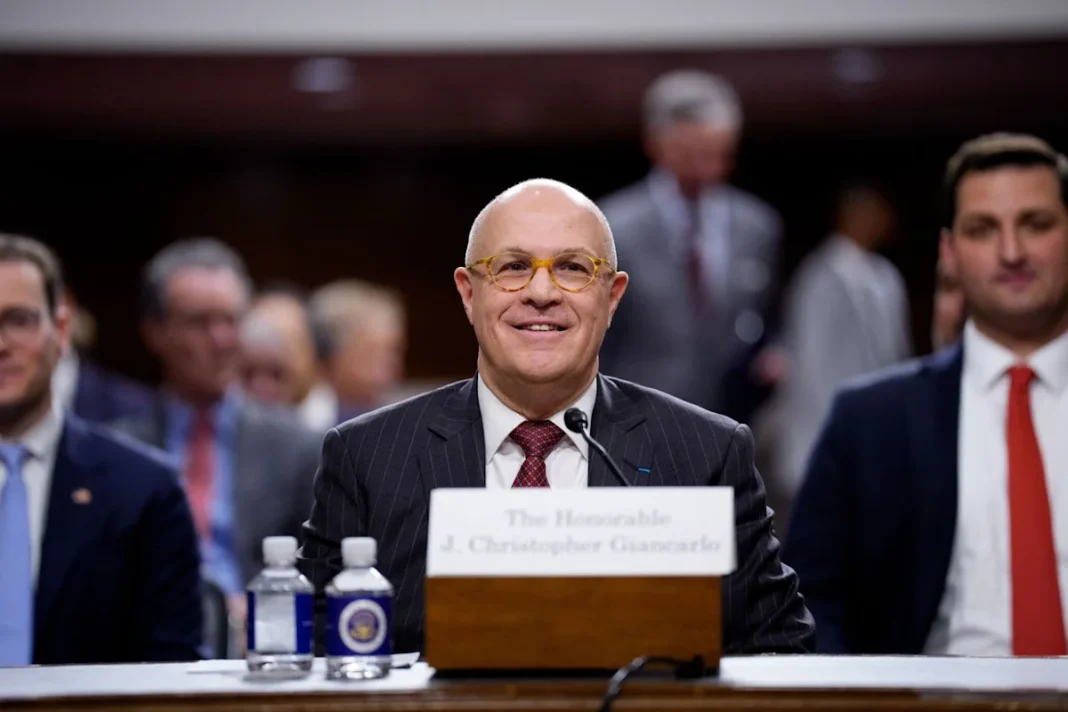

The failure of the CLARITY Act to clear a key Senate vote has created fresh uncertainty for the American digital asset industry. However, former Commodity Futures Trading Commission Chair J. Christopher Giancarlo believes US crypto rules can continue to develop because the Securities and Exchange Commission and the CFTC already have authority to act.
The Senate rejected a procedural motion to advance the House-passed Digital Asset Market Clarity Act by 49 votes to 50. The bill needed 60 votes to move forward, leaving it 11 votes short. Despite the setback, Giancarlo said the vote would not stop innovation or prevent regulators from building a clearer framework for digital assets.
Why the CLARITY Act Failed
The Senate’s vote reflected broader disagreements over how the United States should regulate cryptocurrencies, digital asset exchanges and blockchain-based financial products. Although lawmakers had negotiated revisions, Democratic senators continued to object to provisions involving ethics, enforcement authority and potential conflicts connected to public officials and their families.
Republican lawmakers argued that the bill was necessary to establish long-term certainty for the crypto industry. Democratic lawmakers maintained that the proposed safeguards did not go far enough, especially regarding the relationship between government officials and digital asset projects.
The political dispute meant that the CLARITY Act could not secure the 60 votes required for cloture. The bill remains on the Senate calendar, which means lawmakers could potentially reconsider it. However, the timing of another vote is unclear, particularly with the congressional schedule becoming tighter ahead of the November elections.
Regulators Can Still Move Forward
Giancarlo, widely known in the crypto sector as CryptoDad, said SEC Chair Paul Atkins and CFTC Chair Michael Selig could continue developing US crypto rules under their existing legal powers.
This does not mean agencies can reproduce every element of the CLARITY Act through regulation. Congress would still be needed to create a permanent statutory division of authority between the SEC and CFTC. Nevertheless, regulators can use rulemaking, enforcement guidance, exemptions, and existing market oversight powers to address several unresolved issues.
The distinction matters because the cryptocurrency industry has spent years operating without a consistent answer to a basic question. Is a particular token a security under SEC jurisdiction, a commodity overseen by the CFTC, or a different type of digital asset requiring another regulatory approach?
Clearer US crypto rules could reduce that uncertainty even before Congress adopts a comprehensive market structure law. For businesses, the immediate benefit would be a better understanding of registration obligations, disclosure standards and permissible fundraising methods.
The SEC’s Emerging Crypto Framework
The SEC has already begun working on a separate framework that does not depend on the CLARITY Act. On August 18, the agency proposed Regulation Crypto Assets, a 402-page framework containing registration exemptions and a conditional safe harbor for certain crypto asset investment contracts.
According to the proposal, qualifying issuers could raise up to $5 million over four years under one exemption and up to $75 million during a rolling 12-month period under another. The framework also includes disclosure requirements and a possible path for certain tokens to stop being treated as investment contracts if they satisfy specific conditions.
If adopted, these measures could become an important part of US crypto rules. They may give legitimate blockchain companies a way to raise capital without facing the same legal uncertainty that has affected the sector in recent years.
However, the proposal would not resolve every issue. It would not create a complete statutory framework for digital asset exchanges, nor would it permanently settle the boundary between SEC and CFTC jurisdiction. Those questions remain central to any future market structure bill.
The CFTC’s Role in Digital Assets
The CFTC is also preparing digital asset market structure proposals under its existing authority. The agency’s work could address commodities, derivatives, trading platforms, and other products that fall within its jurisdiction.
A stronger CFTC role could provide a more practical path for digital assets that do not fit the traditional definition of securities. It could also give exchanges and brokers clearer expectations when listing or handling commodity-based tokens.
Still, agency action has limits. US crypto rules created through existing authority may be narrower than legislation passed by Congress. Regulations can also face legal challenges, changes in administration, and disagreements over the scope of agency power.
That is why the industry continues to seek legislation. Regulatory action can provide temporary clarity, but a law would offer greater stability and make the division of responsibilities more difficult to reverse.
Industry Leaders Call for Action
Several crypto industry leaders responded to the Senate vote by urging regulators to act rather than wait for lawmakers.
Coinbase CEO Brian Armstrong said the industry could not continue waiting for Congress and argued that the SEC and CFTC already had tools to establish clearer standards. Ripple CEO Brad Garlinghouse also called on Atkins and Selig to fill the legislative gap.
Senate Banking Committee Chair Tim Scott expressed a similar view. He said regulators should establish clear rules for digital assets until Congress is able to pass legislation.
These reactions reveal a growing concern across the market. Companies need compliance certainty now, not only after a future congressional compromise. Without clearer US crypto rules, businesses may delay product launches, relocate operations or limit services available to American customers.
For investors, the uncertainty can also affect token listings, exchange access, and the legal status of digital asset products. A fragmented approach can make it harder to determine which protections apply and which regulator is responsible.
What the Setback Means for Businesses
The CLARITY Act’s failure does not mean that all regulatory progress has stopped. Companies should expect continued activity from the SEC and CFTC, including rule proposals, interpretive guidance, enforcement decisions, and possible exemptions.
Businesses operating in the sector should focus on several practical priorities. They should review whether their products could fall under securities, commodities, payments or money transmission rules. They should also maintain detailed records of token distribution, marketing claims, governance structures and customer disclosures.
Companies should avoid treating proposed US crypto rules as final rules. A proposal may change substantially before adoption, and its legal status can depend on public comments, court decisions and agency priorities.
The safest approach is to build compliance systems that can adapt. Firms should monitor SEC and CFTC announcements, consult qualified legal professionals, and avoid making claims that suggest a token is guaranteed to appreciate or falls outside regulatory oversight.
What It Means for Investors
Retail investors should not assume that regulatory momentum means every crypto asset is becoming safer. New US crypto rules may improve transparency and accountability, but they cannot eliminate market volatility, fraud, or project failure.
Investors should examine whether a platform clearly identifies the legal status of its products, explains fees, and provides information about custody and withdrawals. They should also be cautious when a company uses the phrase regulatory clarity as a substitute for specific compliance information.
The Senate vote may eventually lead to renewed negotiations rather than immediate legislation. Until then, investors should expect a mixture of agency action, court challenges and political debate.
Can the CLARITY Act Return?
The bill is not automatically dead because the cloture motion failed. Senator John Kennedy said the legislation could return during a lame duck session after the elections, while Senator Ted Cruz described it as mostly dead. A procedural vote by Senator Thom Tillis also preserved a possible route for reconsideration.
Any future version may need to address the same issues that blocked the original vote. These include the division of regulatory power, ethics restrictions, banking access, stablecoin oversight and enforcement responsibilities.
A revised bill could also receive support if lawmakers conclude that continued uncertainty is damaging American competitiveness. But political disagreements remain significant, and a new vote is far from guaranteed.
A Gradual Path to Clarity
The immediate lesson from the Senate’s decision is that US crypto rules will probably emerge through multiple channels rather than one decisive law. Agency rulemaking, enforcement policy, court rulings, and congressional negotiations will all influence the final framework.
Giancarlo’s argument is therefore realistic but limited. The SEC and CFTC can make meaningful progress under their existing authority, but they cannot provide the same durability and certainty as Congress. Regulatory agencies can build a bridge for the industry, yet lawmakers must eventually decide how digital asset markets should be governed in the long term.
For now, crypto companies should prepare for continued regulatory movement even without the CLARITY Act. The legislation may return, but US crypto rules are already being shaped by the actions of federal agencies.